¶ Patras Araxos Airport
The information in this document is not intended for real aviation. It is only intended for computer-based flight simulation.
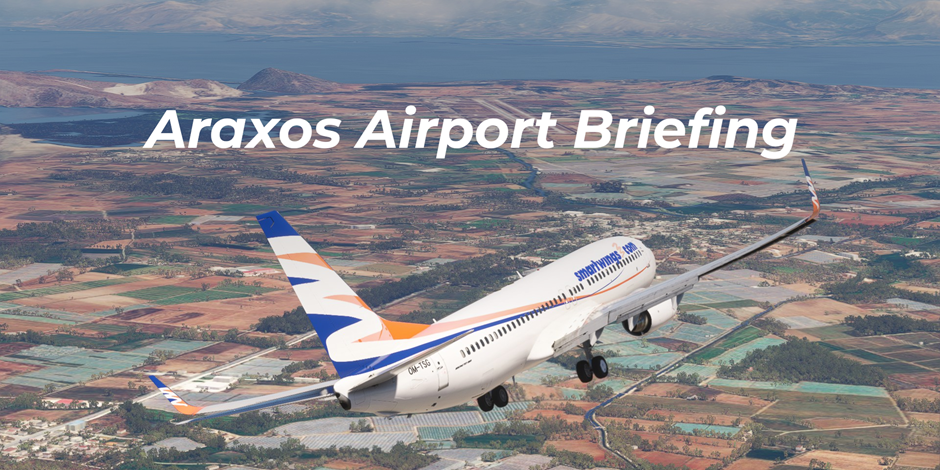
Araxos Airport (LGRX/GPA), located near the third largest Greek city of Patras, is primarily used for military purposes. It is also one of the bases of the aerial firefighting service helicopters of Greece. During the summer season, charter flights are operated here for tourists travelling to the Peloponnese peninsula in search of the sea or ancient monuments. In the real world, the airport doesn't see more than a few civil transport aircraft daily, with movements planned so that there is no more than one aircraft at once at the airport – mainly due to the limited size of the passenger terminal.
This document summarizes essential information you should know for a realistic flight simulator experience.
For more information, please refer to the real-life Aeronautical Information Publication (AIP):
https://aisgr.hasp.gov.gr/
¶ Scenery
Recommended LGRX scenery for MSFS:
jackzyg - freeware
Recommended LGRX scenery for X-Plane:
Julian Lockwood - freeware
Recommended LGRX scenery for P3D:
Greek Sim Design - freeware
¶ Arrival
Runway 18R/36L is used for all aircraft movements. The runway is 3352 metres long, with the runway threshold offset by approximately 200 metres for both directions. The parallel taxiway is marked and lighted as runway 18L/36R, but is used only for taxiing.
There is no ILS nor other form of precision approach system installed at the airport. A VOR procedure is available, which is offset by several degrees in both directions of the runway relative to the runway centerline. Circling approach is not permitted east of the aerodrome due to terrain.
Due to the prevailing winds, runway 36L is in use in most cases. When approaching runway 36L, it is necessary to stay above 3500ft when further than 10 miles from the airport, to avoid the ATZ of the nearby Andravida military base. The angle of the PAPI lights for runway 36L is only 2.5°. Due to the runway profile, the second half of the runway is not visible from the touchdown point.
Araxos Airport provides a great opportunity for a visual approach. The airport is quite large in size and distinctive in relation to its surroundings. It's also not too busy, other traffic won't usually restrict you here.
The runway is equipped with lights. In the real world, however, all flights in and out are scheduled only during the day, and the airport opens at night only by request.
After landing on runway 36L, aircraft usually turn around on the runway and backtrack, or vacate the runway at the end using taxiway A, and taxi via the parallel runway 18L. If landing on runway 18R, aircraft turn around on the runway and backtrack – in practice, taxiing using the parallel runway 36R is not used in real life. In the real world, a follow-me vehicle is available on request.
The civil apron is located west of the runway, at the end of taxiway D perpendicular to the runway. The passenger terminal consists of two small buildings at the south-west corner of the apron.
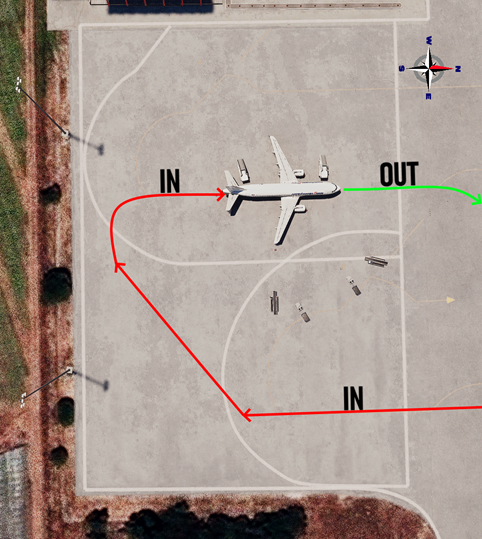
Stands 1 to 4 are marked on the civil apron. However, they are not usually used, and aircraft are most often parked approximately between stands 1 and 2, facing north.
¶ Departure
Pushback is not used here, all stands are designed for independent maneuvering and exit of the aircraft.
Taxiing on the apron must be done carefully, with only the minimum possible thrust and at low speed.
In the real world, the vast majority of departures are done from runway 36L, northbound. It is possible to backtrack the runway and turn around into the departure direction directly on the runway, or taxi via the parallel runway 18L, and enter the runway via taxiway H - in practice both options are used.
All SID procedures include a turn shortly after takeoff with a flyover directly over the airport, as well as a minimum height requred at a certain distance from the airport (i.e. Araxos VOR/DME). However, it is quite common to shorten the SID, with the aircraft continuing from the extended runway centerline directly to the last point of the SID.